To my mind, inspiration is a sudden break of creativity that a person can employ in the creation of a work of art. Literally anything can act as an inspiration, whether it is personally experiencing Michaelangelo's Universal Judgement of Capella Sistina or a casual chat with a friend.
niedziela, 21 października 2012

Presentation notes
My notes, taken during the 3 presentations about masks around the world
The first presentation shown in class was concentrating on masks originating from Africa. It was very informative, presenting both the types of masks and methods used to produce them, along with their main uses. Similarly to Europe, the occupation of a maskmaker was on of the most
sacred in Africa. The basic material for African masks was wood and
valuable examples also incorporated elements made of copper or ivory. Sometimes, sacrificial blood was also an important ingredient for symbolical reasons. The masks often were modelled for animals, so to symbolize a union with nature. Nevertheless, the main area of employment of masks in Africa was ritual purposes. Their ceremonial role was most often to control the lone spirits of a tribe's forefathers.
The subsequent presentation was about the appearance of masks in Europe. It was very interesting and attention-grabbing, despite the fact that the presentation contained very detailed information on the topic. It has shown that the first masks used in Europe were of pagan culture, where they were used for rituals and represented wild animals. Also, an important appearance of masks was in ancient Greek theatre, where they were used for theatrical role-play. Later, the presentation describes the significant role that masks played in Venice, mainly during the carnival. Masks of that period were made with wax cloth and plaster, although silver, gold or other valuable materials were not uncommon in more expensive examples (usually made for usage during the carnival).
The last presentation was the one prepared by my group, it featured masks in Asian culture. Similarly to African masks, Asian masks also found their main use in ritual undertakings and shamanism (for example in Korea or Indonesia). However, for instance Japanese masks were mainly utilized in various forms of art presentation. Other uses include war (the Korean army used masks on soldiers to introduce the factor of fear into the battle). And perhaps the most well-known usage is in the Chinese opera, where exceptionally colorful specimens were employed.
The subsequent presentation was about the appearance of masks in Europe. It was very interesting and attention-grabbing, despite the fact that the presentation contained very detailed information on the topic. It has shown that the first masks used in Europe were of pagan culture, where they were used for rituals and represented wild animals. Also, an important appearance of masks was in ancient Greek theatre, where they were used for theatrical role-play. Later, the presentation describes the significant role that masks played in Venice, mainly during the carnival. Masks of that period were made with wax cloth and plaster, although silver, gold or other valuable materials were not uncommon in more expensive examples (usually made for usage during the carnival).
The last presentation was the one prepared by my group, it featured masks in Asian culture. Similarly to African masks, Asian masks also found their main use in ritual undertakings and shamanism (for example in Korea or Indonesia). However, for instance Japanese masks were mainly utilized in various forms of art presentation. Other uses include war (the Korean army used masks on soldiers to introduce the factor of fear into the battle). And perhaps the most well-known usage is in the Chinese opera, where exceptionally colorful specimens were employed.
sobota, 29 września 2012
A comparison between European and Asian mask making crafts
I have decided to compare certain types of masks that have appeared throughout the world's cultures. I chose to analyse two regions: European and African masks.
European masks
The masks made by europeans in more recent ages were mainly for theatrical use. In this area, they originated from the ancient Greek theatre, which was at its best from 550 to 200 BC. The masks of the ancient theatre represented everything from occupation, age or social class to emotions and the state of mind. In general, there were four types of masks, distinct for the emotions that they represented: fear, laughter, tears and anger. It was the main source of inspiration for the use of masks in the modern western theatre. However, in pagans' culture (which was culture that developed the use of masks) they often represented nature spirits or wild animals and were used during various rites. Also, one of the most prominent appearances of masks in Europe was in Venice, where they were a traditional component of the famous Carnivale. Later on, Venetians also wore masks beside that occasion, which gave them a certain degree of anonymity or signaled belonging to a group of people . There was for example the Medico Della Peste mask, worn by doctors (originally a means of preventing disease contraction). The Medico Della Peste also had a very distinct shape. European masks were in most cases made of wax cloth and plaster.
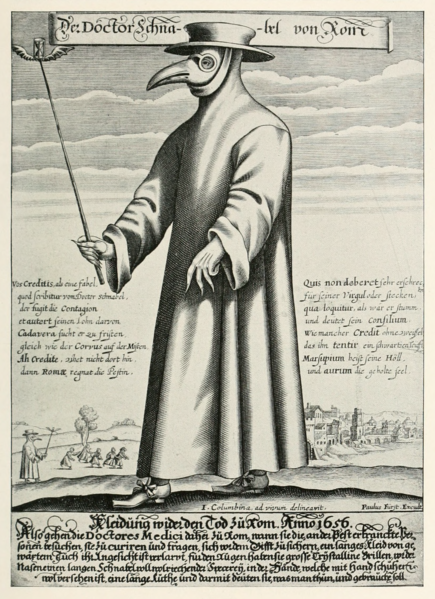 | ||||||
| A Venetian physician wearing a Medico Della Peste mask. | Source | : http://en.wikipedia.org/wiki/Plague_doctor |
Asian masks
Asian masks vary significantly depending on their region of origin (this is due to the fact that this region of the world is dominated by islands and the different cultures had no chance to mingle). For example, Japanese masks are part of a very sophisticated theatrical tradition. The oldest of Japanese masks are the Gigaku. From that basis, the Japanese developed the Bugaku mask - a type of mask with moveable jaws. Japanese masks are also very light, to make it possible for actors to withstand very long performances. The Noh mask is the ultimate development of Japanese mask makers.
On the other hand, masks from Korea were inherently rooted in a tradition of
shamanism and also ritual dance. Korea
has a tradition of remembering the faces of great historical figures
with the use of masks - "death masks". Masks were also used in the art
department, particularly in ritual dances and theatrical plays. The Korean masks found their use during the war, where they served the purpose of scaring off potential enemies when they decorated the faces of soldiers and their horses. During shamanistic ceremonies they were used for burial rites
in jade and bronze and for shamanistic ceremonies to drive away evil spirits. Probably the most notable of appearances of masks in the Eastern culture is the Chinese opera. The colorful facial patterns that we can
see today in the Jingju (Beijing Opera) come from opera masks that have been originally used in a very basic form of opera, performed
without a stage or backdrops of any kind.
The Asian peoples have also used very different materials in their maskmaking processes. Mongols, for example, made masks from paper mache covered in velvet, which were used in the temples of Ulaan Baatar.
 |
| A Japanese Noh mask. Source: http://www.floatingworldeditions.com/books/noh-masks-hell.html |
Personally, I appreciate both European and Asian techniques of making masks. European masks are very often extremely sophisticated when it comes to the materials used. Europeans liked to present their financial status exterally, so for example Venetian masks were regularly decorated with silver or gold plates. On the other hand, Asian masks are more advanced when it comes to the technical aspects: the Japanese masks include moving parts and are overall very complex when it comes to decoration. If I were to make a mask, I would probably use the European technique. I am particularly inspired by the Venetian masks and in my opinion I would be able to make a better mask with the more 'standard' techniques developed by Europeans.
Sources:
Presentations prepared by classmates
http://www.floatingworldeditions.com/books/noh-masks-hell.html
http://en.wikipedia.org/wiki/Carnival_of_Venice#Medico_della_Peste_.28The_Plague_Doctor.29
http://www.ehow.com/about_6639222_information-asian-masks.html#ixzz27sL5E7gP
http://en.wikipedia.org/wiki/Mask
Subskrybuj:
Posty (Atom)